
THE CONTEXT
Beauty Pie is an exclusive buyers' club that democratises access to luxury beauty products. They buy direct from the labs that make the world's top brands, cut out the industry markups, and pass the savings to members. The products are genuinely loved. Vogue Beauty Awards winner. 4.7 out of 5 on Trustpilot. A huge social following.
But the digital experience didn't match the product.
The site had been migrating to a new platform piece by piece, for flexibility, speed to launch, and the ability to run tests.
The last area still to be migrated was the member account space. That's where I came in.
On paper, the brief was technical: migrate the account experience.
In reality, it was an open door into the most underserved part of the customer lifecycle.
I joined a cross-functional team of
-
CX Manager (project sponsor)
-
Data Analyst
-
Product Managers x2
-
Technical Lead
-
Dev team x6
-
Plus one automation partner brought in later: Digital Genius
40%
of cancellations automated
90% +
Resolution rate
95%
CSAT score
£10k
monthly refund risk eliminated

THE CHALLENGE
The business had one priority: acquisition, acquisition... Did I mention acquisition?
Meanwhile, 70% of all customer service requests were members trying to cancel. The only way to do it was email in and wait.
Multiple emails per cancellation, easy to miss. When one slipped through, Beauty Pie was on the hook for retrospective refunds, up to £10k a month. Clearing the queue took two full-time people, around £60k a year.
The cancellation experience was damaging the brand too.
-
The most-viewed FAQ was "How do I cancel my membership?"
-
Trustpilot reviews called it a scam. Members felt Beauty Pie was making it deliberately difficult.
The irony: in a category most people cancel first when budgets tighten, the exit experience was accelerating churn and killing any chance of winning members back.
The biggest retention and cost lever in the business was sitting in an inbox.
And no one was looking.
HOW I APPROACHED IT
Building the case
The business wasn't asking for this work. So before anything, I ran a brief-creation workshop to align stakeholders, share what was already known, and agree what UX could realistically do in three months
It surfaced four member pain points, wish lists, cancellations, up/downgrading, rejoining, and mapped each to both a business outcome and a member outcome.
That framing became my tool. Every time the conversation drifted back to acquisition, I could point to the board and show acquisition was sitting on the other end of the lifecycle, waiting to be unlocked.
'Brought colleagues and different teams together to collaborate and share ideas outside of her day-to-day responsibilities.'
Sathpal Singh
Building the evidence
There was almost no quantitative data on site behaviour. So I built the evidence by
becoming an honorary member of the Member Happiness team, sitting in on calls, reading emails, watching the queue build.
I ran user interviews, analysed Trust Pilot, pulled CSAT scores and cancellation reasons from internal dashboards, and ran competitor analysis across 10+ subscription brands.
The research wasn't neat. It was scrappy, mixed-methods, and embedded in the business. It gave me something no one else in the room had: a clear picture of why members were really leaving.
'Approached research and exploration with clarity and purpose. Connected the dots beautifully.'
Saudin Ceric
Building the buy-in
The insight was counter-intuitive. Friction wasn't reducing cancellations, it was accelerating them. And most members didn't want to leave, they wanted a break.
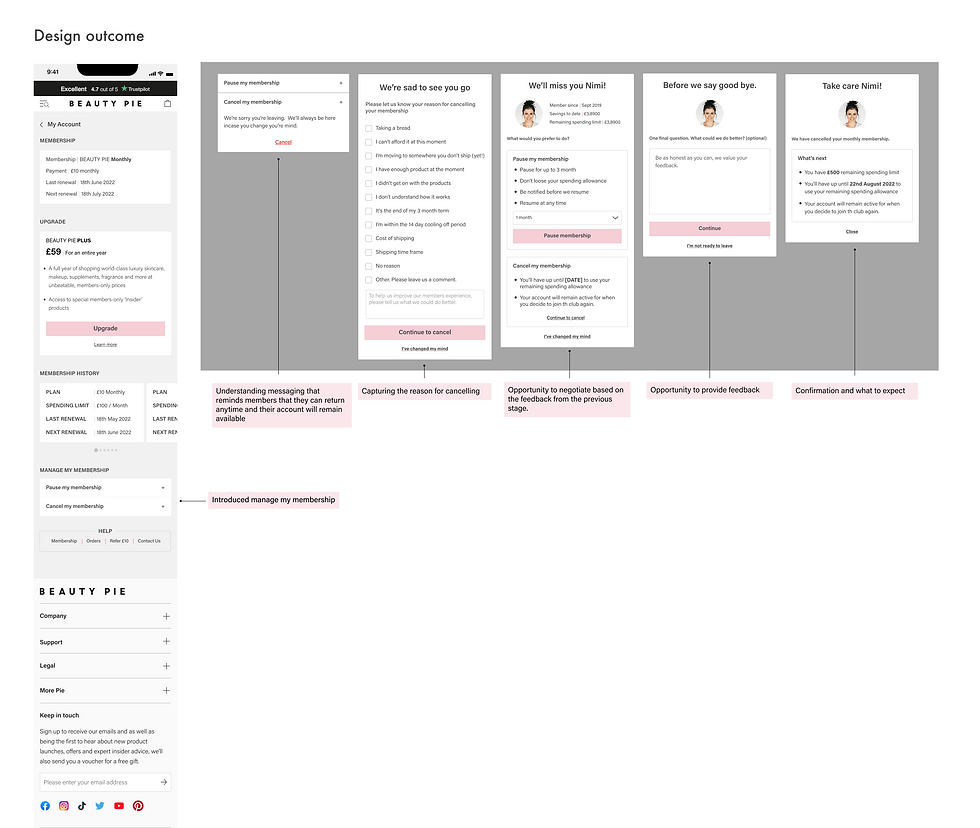
I took that back to the PM and PO and reframed the brief. This wasn't a cancellation feature, it was a Manage my membership proposition with pause, cancel, and feedback built in.
Using a value and effort matrix, we broke it into deliverable chunks and got it on the roadmap.
The business stopped asking for a cancellation fix and started asking for the bigger retention story.
'Really customer focussed, but also has a great eye for commerciality.'
Scott Hodgskin
WHAT I DID

01
Framing the problem
Before jumping into screens, I ran a brief-creation workshop with stakeholders. It mapped four member pain points to business outcomes and member outcomes, giving us a shared view of where UX could add most value in three months.
It also surfaced something the business hadn't said out loud: the cancellation queue was a big operational and reputational risk they weren't addressing.
02
Embedding in the business
I embedded in the Member Happiness team, becoming an honorary member. Sat in on calls, read emails, watched the queue build in real time. Ran user interviews, analysed Trust Pilot feedback, and pulled CSAT scores and cancellation reasons from internal dashboards.


03
Looking outside
I ran competitor analysis across more than 10 subscription brands (Netflix, Audible, Amazon, Dropbox, Dermatica, Beer52, Oddbox, Grind, Skin + Me, The Beauty Chef) to understand how mature businesses handled cancellation, pause, and retention.
Alongside this, I used the Baymard e-commerce audit as a benchmark for the wider account experience.
04
Reframing the brief
The research pointed clearly to two insights. Friction was accelerating churn, not preventing it. And most members didn't want to leave, they wanted a break.
I took this back to the PM and PO and reframed the work: not a cancellation feature, but a Manage my membership proposition. We used a value and effort matrix to break it into roadmap-ready chunks.

05
Designing for automation
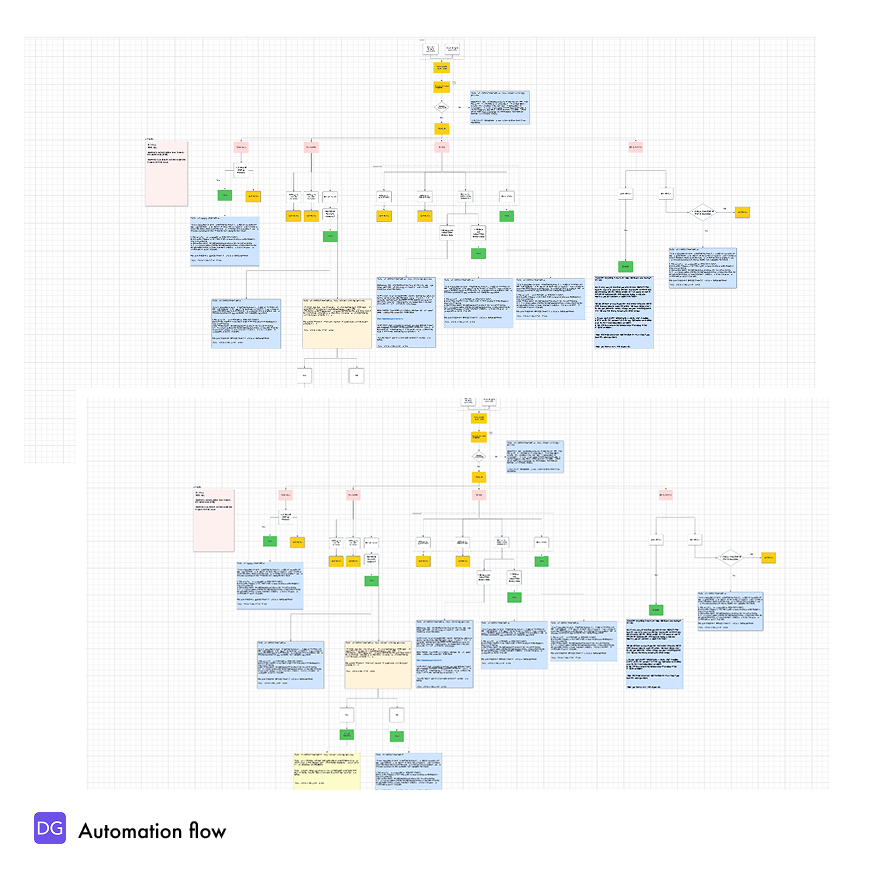
To address the queue immediately while the bigger proposition was built, we partnered with Digital Genius to automate routine cancellations.
I trained myself on Zendesk and worked directly with their team to define the cancellation logic, when to automate, when to hand to a human, and what each message should say.
Phase one automated the routine cases. Phase two folded in the full pause proposition.
THE WORK
THE OUTCOME
The redesigned flow shipped in two phases. The automation partnership went live first, unlocking immediate operational relief. The full Manage my membership proposition followed on the roadmap.
40%
of cancellations automated
90% +
Resolution rate
95%
CSAT improved to
£10K
monthly refund risk eliminated
Beauty Pie has since moved to an annual subscription model, a wider shift that built on the conversations this project started about member flexibility and lifecycle value.
Add paragraph text. Click “Edit Text” to update the font, size and more. To change and reuse text themes, go to Site Styles.
WHAT I LEARNED
The brief you're handed is rarely the brief that matters. The real work is figuring out which problem, if solved, would unlock the most value, and then building the influence to go and solve it.
The thing I'm proudest of isn't the design. It's that the business wasn't asking for this work at all, and by the end, was asking for more of it.
That happened because I treated the project as a chance to evangelise what UX is. Every workshop and research readout was also a demonstration: this is how we frame a problem, this is why we talk to the customer, this is what changes when you do.